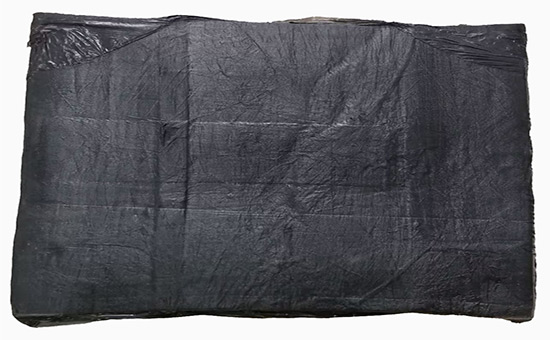
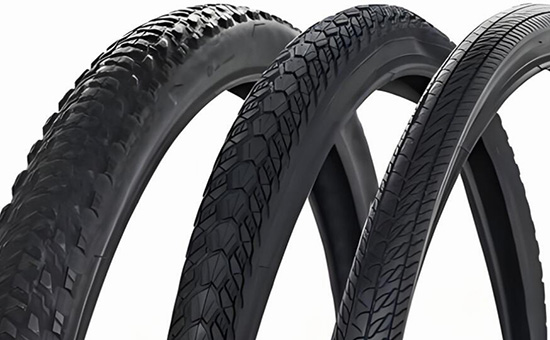
Tire reclaimed rubber is made from waste tire rubber powder as raw material, possessing certain plasticity and viscosity. It can be processed and re-vulcanized, replacing part of natural rubber and reducing raw material costs. Bicycle tire tread rubber is the outermost layer of the tire that directly contacts the road surface and has a patterned surface. It has strict requirements for elasticity and wear resistance. Using both rubber and plastic balances rubber elasticity and plastic rigidity, but the cost is relatively high; Adding an appropriate amount of tire reclaimed rubber can reduce raw material costs and improve the processing performance of the compound.
1. The amount of tire reclaimed rubber used in rubber, plastic, and bicycle tread rubber
The main components of tire reclaimed rubber are natural rubber, synthetic rubber, and carbon black. Its Mooney viscosity is relatively low, prone to rolling, and its physical and mechanical properties are inferior to virgin rubber. Adding large amounts directly disrupts the phase balance E6LYY323 of the rubber and plastic, causing a sharp drop in hardness and modulus. Therefore, strict control of the tire reclaimed rubber content ratio is necessary. Generally, high-performance rubber-plastic combined bicycle tread rubber can contain 10-30 parts tire reclaimed rubber, while low-cost bicycle tread rubber can be increased to 80-100 parts or even fully reclaimed rubber.
Rubber-plastic combined bicycle tread rubber is mixed with a mixer. In the first stage of mixing, natural rubber and styrene-butadiene rubber are first added for plasticization, followed by tire reclaimed rubber and high-styrene resin for mixing. The temperature is controlled at 110-120°C, followed by carbon black, fillers, and softeners, with the discharge temperature not exceeding 140°C. Two-stage mixing and vulcanization system, temperature controlled at 90-100°C × 5-6 minutes to prevent burning. Extrusion forming temperature is 80-90°C, vulcanization conditions are 145-150°C× 15-20 minutes.
2. Rubber-plastic combined bicycle tread rubber combined with tire reclaimed rubber vulcanization formula
Formula 1: Natural rubber 45 parts, cis-butadiene rubber 35 parts, low-density polyethylene 10 parts, tire reclaimed rubber 10 parts, zinc oxide 5 parts, stearic acid 1.3 parts, paraffin 1.5 parts, antioxidant 4010NA 1 part, antioxidant BLE 1 part, carbon black N220 25 parts, carbon black N330 20 parts, engine oil 5 parts, pine tar 5 parts, accelerator DM 1 part, accelerator CZ 0.8 parts, sulfur 2 parts; A total of 168.6 units.
Formula 2: Rubber-plastic master rubber 55 parts, cis-butadiene rubber 15 parts, natural rubber 15 parts, tire reclaimed rubber 15 parts, zinc oxide 5 parts, stearic acid 2 parts, antioxidant D 0.5 parts, antioxidant 4010 1 part, carbon black N220 10 parts, carbon black N330 30 parts, light calcium carbonate 18 parts, engine oil 5 parts, rosin 1 part, coumalong resin 3.5 parts, accelerator DM 0.25 parts, accelerator CZ 0.85 parts, sulfur 1.2 parts; A total of 178.3 units.
Formula 3: Natural rubber 45 parts, cis-butadiene rubber 30 parts, low-density polyethylene 10 parts, tire reclaimed rubber 15 parts, zinc oxide 5 parts, stearic acid 1.3 parts, paraffin wax 1 part, antioxidant 4010NA 1 part, antioxidant BLE 1 part, carbon black N220 30 parts, carbon black N774 10 parts, engine oil 5.5 parts, pine tar 3.5 parts, accelerator M 0.2 parts, accelerator DM 0.5 parts, accelerator CZ 0.7 parts, sulfur 1 part; A total of 160.7 units.
Bicycle tire tread rubber must balance wear resistance, flex resistance, slip resistance, and molding performance. Using an appropriate amount of tire reclaimed rubber in the rubber-plastic formula can effectively reduce raw material costs while ensuring the core performance of the tread rubber, enabling the recycling of waste tire resources.
Exclusive original article [commercial authorization] reprint, excerpt and excerpt in any form are prohibited without written authorization. Focus on Hongyun rubber: learn the process formula and raw material technology of producing rubber products from recycled rubber to help you reduce costs and increase profits