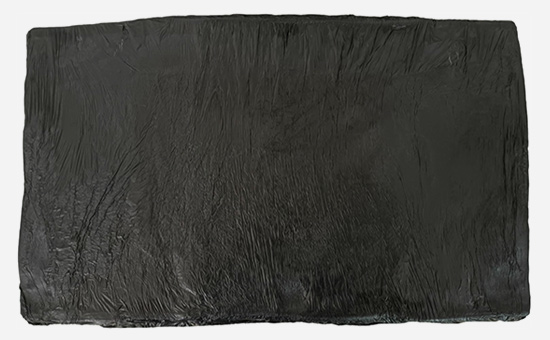
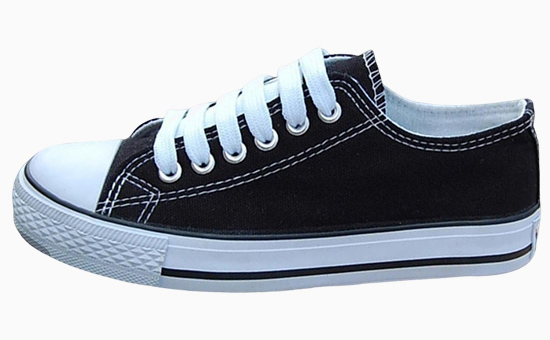
The hard midsole of canvas rubber shoes mainly serves to support the shoe structure, maintain the shoe shape, and improve wearing stability. It requires the rubber material to have appropriate hardness, stiffness, wear resistance, and dimensional stability. Tire reclaimed rubber is made from scrap tire rubber powder, and it has certain tensile strength, tactile elasticity, and wear resistance. It can be used alone or combined with natural rubber or styrene-butadiene rubber to produce the hard midsole of canvas rubber shoes, effectively reducing raw material costs.
1. Key Points for Formulating Hard Midsoles of Canvas Rubber Shoes Using Tire Reclaimed Rubber
(1) Rubber Selection
For hard midsoles of canvas rubber shoes, the rubber content is controlled among 5%-10%. Tire reclaimed rubber can be used entirely, or combined with a small amount of natural rubber or styrene-butadiene rubber, with the reclaimed rubber amount being 8-10 times that of raw rubber. Tire tread reclaimed rubber E6LYY7824 has high strength, good elasticity, low density, wear resistance, and flexibility, making it suitable for producing hard midsoles. This allows for reducing production costs while ensuring midsole performance. The overall performance of the midsole can be adjusted through the reinforcement system and vulcanization system.
(2) Vulcanization System: When producing hard midsoles with tire reclaimed rubber, a sulfur-accelerator system is commonly used. Accelerators M, D, and DM are combined with sulfur to adjust the vulcanization speed and cross-linking structure.
(3) Reinforcement and Filling System: For formulas using tire reclaimed rubber as the main material, carbon black is often used for reinforcement, while calcium carbonate, clay, or kaolin are used as fillers. The amounts of carbon black and inorganic fillers can be appropriately adjusted. If necessary, a small amount of crushed fabric scraps can be added to improve flexibility and the hardness of the midsole after vulcanization.
(4) Softening System: Commonly used softeners include naphthenic oil or Gum Rosin, with the softener amount being controlled.
2. Practical Reference Formulas for Hard Midsoles Using Tire Reclaimed Rubber
(1) Formula for Hard Midsoles with Tire Reclaimed Rubber
Tire reclaimed rubber 80 parts, styrene-butadiene rubber 20 parts, zinc oxide 3 parts, stearic acid 1.5 parts, antioxidant RD 1 part, carbon black N330 30 parts, heavy calcium carbonate 30 parts, naphthenic oil 5 parts, accelerator M 0.5 parts, sulfur 1.8 parts; total 172.8 parts.
Tire reclaimed rubber 95 parts, natural rubber 5 parts, zinc oxide 3 parts, stearic acid 1 part, antioxidant D 1 part, clay 15 parts, solid gum rosin 1.5 parts, liquid gum rosin 3 parts, accelerator M 0.5 parts, accelerator DM 0.5 parts, accelerator D 1.4 parts, sulfur 1.1 parts; total 128 parts.
When using tire reclaimed rubber to produce hard midsoles, attention should also be paid to mixing and vulcanization processes. It is recommended to add sulfur and accelerators after the rubber has cooled to avoid scorching due to high mixing temperatures. For mold vulcanization, the vulcanization temperature, pressure, and time need to be determined based on the thickness of the product, mold structure, and rubber vulcanization characteristics. Fixed process parameters should not be applied directly. Related process tips will be shared later.
Exclusive original article [commercial authorization] reprint, excerpt and excerpt in any form are prohibited without written authorization. Focus on Hongyun rubber: learn the process formula and raw material technology of producing rubber products from recycled rubber to help you reduce costs and increase profits