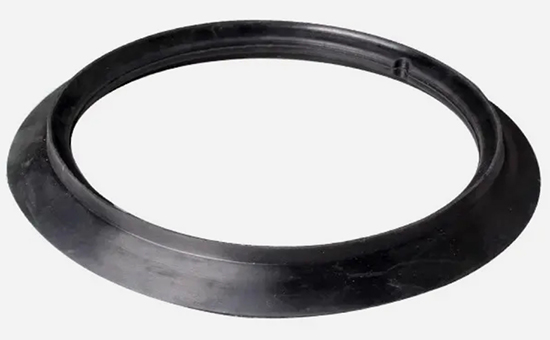
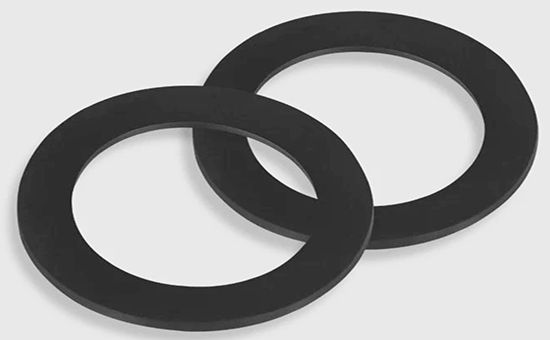
Pipeline sealing rings are mainly used for sealing interfaces of water supply and drainage pipes, sewage pipes, and some industrial pipelines. They have certain requirements for the elasticity, permanent compression deformation, water resistance, and aging resistance of the rubber material. EPDM rubber has excellent weather resistance, ozone resistance, water resistance, and heat aging resistance, and is gradually replacing natural rubber in the production of pipeline sealing rings, providing a longer service life. Recycled EPDM retains the basic performance characteristics of EPDM rubber, is cheaper, and can be used together with natural rubber to produce pipeline sealing rings, reducing costs.
1. Advantages of using natural rubber and recycled EPDM together for pipeline sealing rings
In actual production, natural rubber and recycled EPDM can complement each other when used in the right proportions. Natural rubber has good flexibility and uniformity, and after vulcanization, it can achieve high tensile strength, elasticity, and tear resistance, providing the sealing ring with high elasticity and mechanical strength. Recycled EPDM retains the weather, ozone, and water resistance of EPDM rubber. When used with natural rubber, it can enhance the aging resistance of the sealing ring and improve the processing of the rubber material.
2. Issues to consider when producing pipeline sealing rings using recycled EPDM and natural rubber together
Natural rubber and recycled EPDM are poorly compatible. When used together, the mixing ratio must be strictly controlled, and compatibilizers and co-vulcanization systems should be used to avoid problems like delamination, poor adhesion, and sealing failure in the finished products.
(1) Proportion of recycled EPDM
When natural rubber is the main base, 10%-30% recycled EPDM can be added to balance compatibility and cost. When recycled EPDM is the main base, 5%-10% natural rubber can be added.
(2) Designing the vulcanization system for natural rubber/recycled EPDM blends
Natural rubber vulcanizes quickly with sulfur, while recycled EPDM has residual cross-linked networks and vulcanizes slowly, leading to mismatched vulcanization rates, possibly causing over-crosslinking of NR and under-crosslinking of EPDM with uneven overall crosslink density. When using a sulfur system, accelerators like TMTD/TRA must be added and their amounts slightly increased, but synchronization is still not as good as with peroxides. It is preferable to use a peroxide system (2-3 parts DCP) + co-crosslinking agents (1-2 parts TAIC); peroxides can trigger crosslinking for both saturated and unsaturated rubbers, resulting in more uniform co-vulcanization.
3. Reference formula for producing pipeline sealing rings with recycled EPDM and natural rubber
Recycled EPDM 90 parts, natural rubber 10 parts, zinc oxide 3 parts, stearic acid 1.5 parts, carbon black 10 parts, calcium carbonate 20 parts, paraffin wax 1 part, paraffin oil 6 parts, Guma resin 1.5 parts, accelerator CZ 0.7 parts, accelerator DM 0.6 parts, accelerator TMTD 0.1 parts, sulfur 1.2 parts; total 145.6 parts.
4. Key production points for pipeline sealing rings using recycled EPDM and natural rubber
When producing sealing rings with natural rubber and recycled EPDM, attention must be paid to the dispersion state of the two rubbers during mixing. If necessary, mix in stages, controlling the temperature and time to avoid local overheating and uneven dispersal of additives. For molding and vulcanizing the sealing rings, consider the product thickness, mold structure, and rubber vulcanization properties to ensure proper size and intact sealing surfaces.
Producing pipeline sealing rings using recycled EPDM and natural rubber requires strict control of the mixing ratio, careful formulation design, and appropriate adjustment of production process parameters. The finished sealing rings can have high elasticity, tensile strength, and tear resistance, while significantly improving their outdoor and wet environment service life, effectively reducing production costs.
Exclusive original article [commercial authorization] reprint, excerpt and excerpt in any form are prohibited without written authorization. Focus on Hongyun rubber: learn the process formula and raw material technology of producing rubber products from recycled rubber to help you reduce costs and increase profits