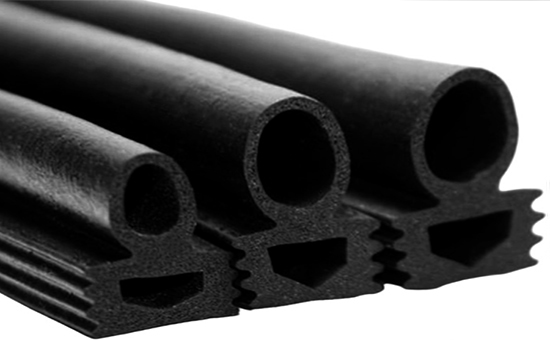
EPDM reclaimed rubber has excellent resistance to high and low temperatures, ozone resistance, and weather resistance. It can be used alone or combined with EPDM rubber and butyl rubber to produce rubber sealing strips, effectively reducing raw material costs. When producing rubber sealing strips with EPDM reclaimed rubber, dimensional stability directly determines sealing performance and product lifespan; How can the dimensional stability of EPDM reclaimed rubber sealing strips be improved?
1. Tips for choosing raw materials for EPDM reclaimed rubber sealing strips
When producing rubber sealing strips mainly from EPDM reclaimed rubber, priority should be given to reclaimed rubber with low volatile matter, low moisture, and uniform desulfurization, to avoid shrinkage after vulcanization rubbers cool. Using EPDM reclaimed rubber together with EPDM rubber can further improve the crosslinking density and structural stability of sealing strip compounds. When using powdered additives such as heavy calcium or talc powder in EPDM reclaimed rubber sealing strips, attention must be paid to moisture absorption of the powder. If necessary, drying should be carried out to improve the dimensional stability of EPDM reclaimed rubber sealing strips.
2. Key points for choosing additives for EPDM reclaimed rubber sealing strips
(1) Vulcanization system: When producing rubber sealing strips for reclaimed EPDM, the peroxide vulcanization system is preferred. Vulcanized rubber has less permanent compression deformation and lower thermal shrinkage compared to sulfur vulcanized rubber; When sulfur vulcanization is necessary, it can be used together with long-acting accelerators to ensure full positive vulcanization. Under-sulfur and over-sulfur are strictly prohibited, and the dimensional stability of the finished EPDM reclaimed rubber sealing strip is improved.
(2) Reinforcing the filling system: The formulation of EPDM reclaimed rubber sealing strips can appropriately increase the amount of inorganic fillers, such as heavy calcium, talc powder, calcined kaolin, etc., which have low shrinkage rates; Use semi-reinforced or general-purpose carbon black reinforcement in moderation; High-structure carbon black increases shrinkage and internal stress, so it should be used sparingly; The higher the proportion of inorganic fillers, the lower the overall shrinkage rate of the compound, resulting in more stable finished dimensions of EPDM reclaimed rubber sealing strips.
(3) Softening system: When using softeners to improve the processing performance of EPDM reclaimed rubber, it is recommended to choose high flash point and low-migration naphthenic oil/paraffin oil; Inferior aromatic oil easily migrates and releases oil, causing the sealing strip to expand and deform later; its use should be prohibited; Reasonably control the amount of softener used; excessive amounts can cause EPDM compound to become soft, oily, shrink after cooling, and prolonged creep and deformation; For rigid EPDM reclaimed rubber sealing strips, try to add less or no plasticizing oil.
3. Key Processing Points for EPDM Reclaimed Rubber Sealing Strips
(1) Key points of the rubber-mixing process for reclaimed EPDM rubber sealing strips
When producing rubber sealing strips with EPDM reclaimed rubber, uneven mixing and excessive internal stress can cause continuous rebound deformation of the sealing strip. EPDM reclaimed rubber can be milled into thin tubes, breaking up rubber blocks to E6LYY113 and improving uniformity; Standardize feeding sequence to prevent local accumulation of vulcanizing agents causing scorching and uneven vulcanization; Control the mixing temperature during mixing to prevent premature scorching of the compound and uncontrolled volatilization of low molecular weights; Leave the compound rubber for 8-24 hours to fully release internal stress, preventing warping and shrinkage after forming.
(2) Key points of the vulcanization process for EPDM reclaimed rubber sealing strips
When using an extruder for EPDM reclaimed rubber sealing strips, it is recommended to control the extrusion temperature and keep the die slightly lower; If the extrusion temperature is too high, the compound will be too fluid, resulting in large free shrinkage after exit; Excessively low temperatures cause high extrusion pressure, sharply increasing stress inside the sealing strip. When extrusion of the reclaimed rubber sealing strip, the material is discharged at a uniform rate, but the speed fluctuates among fast and slow, directly causing the cross-sectional size to fluctuate among large and small; After extrusion, quickly fix the shape; do not allow the compound to shrink in the air.
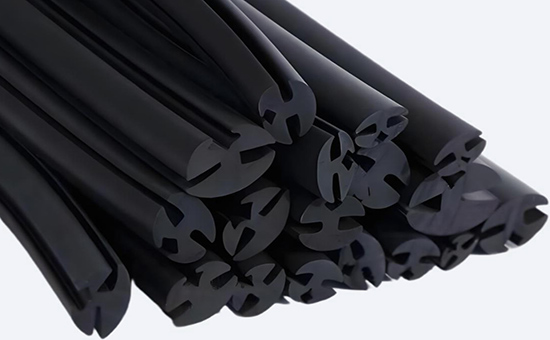
Premium environmentally friendly ultrafine EPDM reclaimed rubber uses high-quality EPDM die head rubber as its main raw material. It has physical properties such as resistance to high and low temperatures, aging resistance, high insulation, ozone resistance, and corrosion resistance. Compared to EPDM reclaimed rubber, it also features higher rubber content, no odor, good elasticity, and a smooth, shiny product surface. It is an ideal raw material for producing extruded EPDM rubber sealing strips and reducing costs. It can significantly reduce raw material costs while ensuring the quality of rubber products, and the finished product dimensions are stable.
Exclusive original article [commercial authorization] reprint, excerpt and excerpt in any form are prohibited without written authorization. Focus on Hongyun rubber: learn the process formula and raw material technology of producing rubber products from recycled rubber to help you reduce costs and increase profits